Showing posts with label Books. Show all posts

Friday, March 02, 2012

A Memory: Terracotta Turtle

Siena, Italy
As part of World Book Day yesterday, the authors over at The Edge are doing a book giveaway. Each author is giving away one of their books. Now, I'll be straight up and say that I want to win, but it would seem a bit strange if I had no competition, so go over to this post over at The Edge and follow the instructions to have a chance of winning books by Miriam Halahmy, Keren David, Bryony Pearce, Paula Rawsthorne, Sarah Grant, Savita Kalhan, Katie Dale and Dave Cousins (more about him at a later date to be announced).
Posted by Picasa

Tuesday, February 14, 2012

Moments in Love

Today I should be going to have my 'submission package' critiqued, by my critique group but because it's THAT day of the year, the bubba and I will be supping on jacket potatoes and beans. It's not just because the Frog is on a business trip this year that I'm a tad moany, it's that actually I'm just not a big fan of Valentine's Day. I've never bought it. As a teenager it was a popularity contest and the one and only time I got an anonymous card, I knew who it was from and my feelings were not reciprocal. To me it is yet another excuse to give money to hallmark and chocolate companies, but is that love? Not in my book.

But you know, that doesn't stop me from being a big soppy romantic. I believe in those special moments.  

Gustav Klimt's The Kiss - Those snuggly moments on the sofa on friday night, as you doze in each other's arms while there is some tosh on TV. 


Art of Noise Moments in love - There's just something about that moment when you take out a record and hold it carefully, ensuring no fingerprints are transferred onto the vinyl. Then you slip it onto the turntable. I had a 12" of Moments in Love and this amazing record player that would clunk and then brrrbuzzclunkchunk to the other side of the record. You could stick it on repeat and listen for hours and hours and hours. 


(I never ever saw the video, but I have to say my teenage fantasies did not include tortoises)

Alain de Botton On Love - I don't agree with all of it, but the part on falling in love is classic. 

Pablo Neruda Twenty love poems and a song of despair - erotic love poetry, not really to be read on the bus. 

And coming in at number one for me Julian Barnes A History of the World in 10 1/2 chapters. The half chapter is called Parenthesis. I once wrote a poem about it. And here are some quotes from Parenthesis to whet your appetite: 
[I love you] We must keep these words in their box behind glass. And when we take them out we must be careful with them.  pg. 277
And so it is with love. We must believe in it, or we're lost...If we don't then we merely surrender to the history of the world and someone else's truth. pg 296 

Saturday, January 14, 2012

Cultural characters

The other day I was checking my Twitter feed on the way to work when I came across one that linked to a now taken down article in The Guardian and stated that French parents were better than me. Of course, that was bound to set my blood boiling and my little thumbs furiously smacked out a reply all about those great French parents. Then I planned a great big long rant about French and UK parenting, before remembering that this was a writing blog. 

By the time I got to work (having already tweeted the 140 characters of aforementioned rant) I had that little moment to reflect on the fact that my child is half Brit, half French. In our parenting combo, right from the off, everything the other did was wrong. Totally wrong. Not because it was wrong, but because we were brought up differently. Where the Frog suffers (and believe me it shows all over his face) the indignity of having to put his child on time out and then asking the child if she understands why she was on time out, I have to chew my lips when I can see the three year old is dying to leave the table, but we haven't all finished eating yet. We're different. It's different, there's no right or wrong parenting. The book French Children Don't Throw Food, may purport French parenting styles, and we may read it to further our understanding of social anthropology in the same way that we might read A Year in the Merde, but we're not actually going to start acting like the French, because we're culturally programmed not to.

Which brings me to writing. I've lived here for eleven years, before that a couple of years in Madrid and before that Mexico. This year I can no longer vote in the UK, I am well and truly an ex-pat, yet I still write British characters. I can't stop. I just don't feel equipped to write a French one, and wouldn't dream of writing a Spanish or Mexican. I may put them in as minor characters, but as a main I wouldn't dream of it. I think that as my child grows up, I'll be in a unique position to write the French character and may even do so one day, but at the moment it's easier to create a whole new fantasy world.

And then boys? Do I write boys? Yes, British boys. But I was reading this blog the other day: Interview with Shelly Harris, and she raised the point:
I was surprised how much I had to learn about a male viewpoint, and how different it can be from that of a woman. 

She also wrote from an  British Asian point of view and talks about how she went about making the voice authentic. And that is the point. I'm not saying we shouldn't do it. Having just reviewed Unhooking the Moon, by Liverpudlian author Gregory Hughes, one of the things that I really liked about the book was that the characters seemed real. As writers we can write from a male/female POV or a Peruvian one, if we so wish, we have that liberty, but we have to make it true.

And just to prove this was a writing post, books mentioned during this post:
French Children Don't Throw Food by Pamela Druckerman
A Year in the Merde by Stephen Clarke
Jubilee by Shelly Harris
Unhooking the Moon by Gregory Hughes.

Wednesday, November 09, 2011

November British Book Challenge: Cloud Atlas

Title: Cloud Atlas
Author: David Mitchell
Published: Sceptre, 2005
Synopsis: 
A reluctant voyager crossing the Pacific in 1850; a disinherited composer blagging a precarious livelihood in between-the-wars Belgium; a high-minded journalist in Governor Reagan’s California; a vanity publisher fleeing his gangland creditors; a genetically modified “dinery server” on death-row; and Zachry, a young Pacific Islander witnessing the nightfall of science and civilisation -- the narrators of Cloud Atlas hear each other’s echoes down the corridor of history, and their destinies are changed in ways great and small.


In his captivating third novel, David Mitchell erases the boundaries of language, genre and time to offer a meditation on humanity’ s dangerous will to power, and where it may lead us.

from Amazon.com

Star parts: I read Black Swan Green a good few years ago, and it's a novel that's stayed with me. The MC in that book is a little older than I was in 1982, but I could relate to the lens through which he lived those years. So having really enjoyed that book and having heard some stuff about Cloud Atlas I thought I'd get it. So straight away this book is so different. Secondly, I don't read historical fiction, so on it's own, I probably wouldn't have picked up Adam Ewing's journal or the Letters from Zedelghem. I have no patience for crime fiction, so the Luisa Rey mystery probably wouldn't make it onto my shelf. Timothy Cavendish's story was amusing, I haven't read sci-fi for years and as for dystopian futuristic novels, they are generally on hold at the moment. So having detailed how I wouldn't read any of these books individually, let me tell you how I raced through the first half of the book. Some of the facts of Adam Ewings journal are historically factual. The story was fascinating, although I worked out the twist, but the characters seemed extremely authentic to me and then it ended. In the middle of a sentence at that. 

The Zedelghem journal reminded me a little of Fitzgerald. I loved the Luisa Rey's diaries. Here I recognised the Mitchell of Black Swan Green. He recreated the late seventies, the party scene, the changing face of society with women in top jobs, but just early enough to be lacking some key technology. Cavendish's story takes us to England and plays with the idea of memory and people's perceptions of what we remember. I found this part poignant and amusing. I liked Somni's story if only because the brands have taken over the world. It's not so far from reality people. Then Zachary's story was, I think the best. Again Mitchell played with language and dialect, but I liked it because in the end it was the one story that went from beginning to end. It made me question who we are as humans and all our beliefs. Also in this story and the orison story the characters were naive and yet completely authentic.

Black clouds: But by the second half of the book, I slowed right down. All the clever interweaving was clear now (I thought) and I enjoyed some of the stories more than others. Plus because of the way the stories were split up, I felt like I'd forgotten some of the details of the first part of the stories.
  
   Do I recommend it: But you know, in the end the book was pretty amazing, 
 you've got to hand it to Mitchell. When I think of the amount of work that would go into one part of the novel, let alone the six different parts. Then there's the fact that each different part is carefully interwoven into each part. It's an amazing force of imagination and if I could write just one of these novels let alone all six in one book, well you know, I'd be chuffed. So yeah, if you haven't already, read it. But maybe a bit quicker than I did. And I hope you love Zachary's story as much as I did. 


This is the twelfth book I've reviewed for the British Book Challenge, which means that I have COMPLETED the challenge. But more importantly, I've read a dozen more children's and YA books that I did last year and I'd like to thank Becky for the necessary kick up the proverbial backside I needed to do my research. I have read a couple of adult books this year, but I haven't missed them a great deal and I really feel like this challenge has helped my writing. I now have a HUGE pile of books to read by my bedside. So with that, I'm going to head off there right now and carry on reading Unhooking the Moon.

Thursday, September 15, 2011

Who started your dream?

As part of Rach Harrie's 3rd Writer's Platform-Building Campaign I've joined a bloghop organised by Cat Gerlach that explores what and who got us started on this writing journey. There are eleven bloggers in this little circle, if you follow the links at the end of the post you should get to visit them all.

Oh! Silly me, I almost forgot! As well as finding out about our writing influences, there are also PRIZES! That's right prizes. The more blogs you visit, and the more comments you leave, the more chance you have of winning a query crit, a 500 word crit, an e book by William L. Hahn, there are 2 YA novels for grabs, and finally a 30 and 25 page critique.

So without further ado, who started my dream?

About four years ago, I went from writing for a hobby, to 'You know, I think I may just take this seriously'. The authors/writers who helped me reach this decision were one small wee colleague that I had the good luck to be closely working with, and a small group of bloggers who commented regularly on this good ole blog. Their names are: Rhian Saadat (an execellent mentor if ever there was one), Kate Bousefield, Debi Alper, Nicky Schmidt, Seamus Kearney, Derec Jones, Maht Wells, Marie Syemou and Jefferson Davies. These guys were supporting and lovely in a way that helped me make the most terrible writing mistakes ever, while still giving me the confidence to carry on.

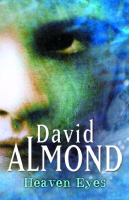
But why did I then start writing children's? Well another colleague leant me Skellig by David Almond and I was completely blown away. I was big into Magic Realism at the time and after I read another of Almond's books Heaven Eyes I decided I was reading the best Magic Realist ever.


A kid in my class passed along Dragon Rider by Cornelia Funke. The kid's book review had not convinced me I would like the book, but I gave it a go despite the animal characters. I really liked it, but reading The Thief Lord shorly after a visit to Venice was just amazing. then there was Inkheart and how my heart bled at the end of Inkspell. So, in case you haven't guessed I'm big into Funke!


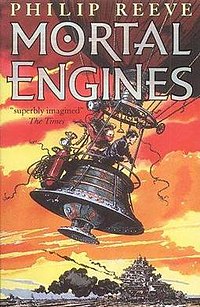
And last but not least, who put the steam into punk? Well in my opinion it was Philip Reeve and Mortal Engines. Shortly after reading that book I cancelled my summer holiday and sat down and wrote for two months solid, joined SCBWI... and... no, there's no happy ending, YET. Still a lot of hard work to do and a lot to learn.

Meanwhile, if you want to here about other influences and great books, you can go one way along the ring by going to Robyn Campbell's blog (yes, she of the interview) or you could go the other way by tootling along to M.G. Higgins blog. And remember to comment (before the 23rd, which is when all the comments will go in a big hat).

Wednesday, September 07, 2011

A Book Review: The Road

Title: The Road
Author: Cormac McCarthy
Published: Picador, 2009


Synopsis:
A father and his son walk alone through burned America. Nothing moves in the ravaged landscape save the ash on the wind. It is cold enough to crack stones, and when the snow falls it is gray. The sky is dark. Their destination is the coast, although they don't know what, if anything, awaits them there. They have nothing; just a pistol to defend themselves against the lawless bands that stalk the road, the clothes they are wearing, a cart of scavenged food-—and each other.
from Amazon.com

Star parts:  I bought this book because it was recommended to me by three people. Two of them tried to tell me about the book without telling me too much, but explained that they had been profoundly moved by the book.

The story unfolds in a post apocalyptic world. I think one of the things that was so horrifying in the book is that it was all so plausible. Nothing rang false, the sights McCarthy described, the sounds, the smells, it just all seemed so plausible. The boy is experiencing a world lacking in innocence and it makes the readers heart bleed. All the boy and the father have is each other, they are each others hope, they are what makes it bearable to keep reading. 

The road is horrific while not being a horror book. It's a beautiful and tender love story between father and son. The descriptions are haunting and throughout it all there is the grey ash that covers everything. It is a moving book for many reasons, not just because I wept all through the final pages and had to go back and read it. The final paragraph is hauntingly beautiful, but after having read the book to me it was actually a chilling lesson.

Black clouds: It's not bedtime reading, which is unfortunately when I do the bulk of my reading. Still that's a personal gripe and thankfully a loooong drive to Italy provided me with all the time I needed to finish the book.  

 Do I recommend it: Totally, it will make your heart break and sing at the same time. 

Thursday, September 01, 2011

Firsts: No Use Crying by Zannah Kearns

Today I'm a bit excited to announce the first in a series of posts where new authors get a chance to spread the news about their debut novel. First up on Firsts is Zannah Kearns. Her debut novel NO USE CRYING is out today in the UK. So if you would like to find out why you should buy the book, what it's like to go from an unpublished novelist to debut author and how important it is to tweet, read on.

Zannah, your debut novel NO USE CRYING is out TODAY, Why should we add it to our to be read lists?

What a question! Because if you all buy it then my publishers will be more inclined to keep me on?! Because I do actually believe it's a book 'with heart'. The characters are like dear friends, and I hope you might fall in love with them, too. It's funny, heart-warming, and raises some interesting areas of discussion: when does a secret become a lie, how is our identity formed, how do we forgive - ourselves as much as others - how do our relationships evolve as we change/grow?

Wow! There are some big themes there; very intriguing themes might I add.  Can you tell us a little bit about your story now. How did you go from unpublished writer to debut author?
 
I've loved books all my life, but only started taking the idea of writing seriously at University when I took some creative writing modules. I think until then it had felt like a bit of a guilty secret, just too unrealistic. I was fortunate that my parents funded me through an MA after university, so I did Creative Writing then, and whilst I went on to do 'normal jobs' for a while, I kept on writing and I think that's what proved to me it was what I really wanted to do as I kept going. 
 
I had one of those fortuitous moments that will make aspiring authors want to kick me in the shins (we're way too nice to do that Zannah)- my friend asked to read my manuscript and then a month or so later she texted to ask if I'd mind if her sister read it 'as she's a literary agent' (can she be my friend too?). My friend had already shown it to her sister who liked it and wanted to follow up, but that was the first time I heard about it. I do reassure myself that there is more to it than luck though, as my agent wouldn't have said yes if she didn't think she could actually sell it, and the publishers have no connections to me! But I think it probably got me an initial 'real reading' from someone who gets hundreds of manuscripts landing in her mailbox every single day, so I was certainly fortunate.
 
OK, so apart from being lucky (although you did have a finished MS there), what are the three things that have helped you the most in your writing journey?
Learning to take criticism. That particularly came about through my MA - having work critiqued so frequently. I'm not precious about my writing - if someone says a bit needs changing, I listen, and I know if I feel particularly attached to a phrase or scene, it's probably self-indulgent and needs to go!
 
Learning that I have to make the time... I had a year when I was 'between' jobs a little while back, and I probably wrote less that year than any other. I think life informs art, and maybe especially writing. Nothing is wasted in that way, so being a full-time mum of two small children doesn't have to hinder my work.
 
Amazing people. My agent and editors (and all at Frances Lincoln) are passionate about their work, and highly skilled. I have huge confidence in their expertise, and they have made the whole process of getting No Use Crying ready for publication a thoroughly enjoyable one. They have definitely made my writing better.
 
What advice would you give to unpublished writers?
First, enjoy stories. I think there are times when I've become more obsessed with the idea of being published, or being 'a writer' than simply taking delight in my imagination and the creative process. If I now never get published again, I'd still write because I love it. 

Next, it's all about the re-writing. It is liberating to let your first draft be however rubbish it's going to be, but to just get the words down on the page, and then there's something to work with. Re-write, re-write, re-write. You'd be surprised by how much something can improve with multiple drafting!

Don't send out your work too soon! The amount of info online - from getting submissions to their top-notch standard, to how to write query letters, to every other tiny little detail you might need to know is all there to be able to send out your work to its best possible advantage. But doing all that research can distract from getting the story where it needs to be - it's all about the story!
 
I do agree that it's all about the story. And the Frog too, he's always telling me to get on and write, but there is some good stuff online. Well, for a start we met on Twitter, in fact, we've only ever met on Twitter. How important is it to Tweet?
 
Clearly writers still make it these days who aren't on Twitter. But it's undoubtedly fun and useful. I love the buzz of other writers and bloggers sharing their projects (even just to say how much they have done that day, or how the whole day has been sabotaged by little Tommy's mumps). And there are some amazing authors on there who are so ready to share their advice and encouragement. I think if you follow the right people, then it's a thoroughly positive booster for the lonely writer's journey. 

The place to start is with Nicola Morgan's e-book TweetRight. I saw it as a series of posts on her blog Help! I need a publisher! which is full of fantastic advice for aspiring authors (I second that, Nicola's posts helped me take my first tentative steps on Twitter and now I'm interviewing debut authors). That's what got me started on navigating Twitter, and then you receive this amazingly friendly welcome from lovely people like you! (Why thank you) I think it has been useful for networking and promotion, but there is so much more to it than that.
 
Lastly, for a bit of fun three random facts about Zannah Kearns. 
 
1) My favourite smell is my children! They are only 2.5yrs and 4.5 months - and they smell like malted biscuits, all sweet and milky, and I love how they smell with suncream on, and when they're soapy-clean after their baths... Sometimes obviously they smell of other, less delightful things, but we won't worry about that... (No let's not, I've just been through a very traumatic potty training summer).
 
2) I am slightly addicted to two tv series - Gilmour Girls and West Wing. They are very warm and funny, and you can feel slightly intelligent watching West Wing (except if someone asks me what's actually happening as it quickly becomes clear I haven't a clue!) The dialogue in these series is superb,so really when I watch them it counts as research, you know...

3) I spent a year after school living in Chantilly, just south of Paris (to give a French connection!) It's a beautiful racing town, with a chateau that was used in a James Bond movie - Goldfinger, I think. The duke who built the chateau thought he was going to be reincarnated as a horse (so the story goes) so he built stables even larger than the chateau! When we visited the stables, we whispered to each horse in turn, 'Are you the duke?' None confessed.
(You did say random, right?!)
 
I did say random and I'm rather embarrassed to say that I have never been to Chantilly. So with that confession I shall begin to wrap up this First First. If you have been convinced to buy NO USE CRYING you can do so through the Frances Lincoln website or the Amazon link below. 
 
If you want to find out more about Zannah Kearns there is a NO USE CRYING page on facebook and there's even more info over at Zannah's website: http://zannahkearns.com/

Wednesday, August 31, 2011

August British Book Challenge 2011: The good man Jesus and the scoundrel Christ

Title: The good man Jesus and the scoundrel Christ
Author: Philip Pullman
Published: Canongate Books ltd, 2010

Synopsis:
This is a story. In this ingenious and spell-binding retelling of the life of Jesus, Philip Pullman revisits the most influential story ever told. Charged with mystery, compassion and enormous power, The Good Man Jesus and the Scoundrel Christ throws fresh light on who Jesus was and asks the reader questions that will continue to resonate long after the final page is turned. For, above all, this book is about how stories become stories. 
from Publisher's website
 
Black clouds: I'm slightly swapping the order of the review this time, because frankly that's how I felt about it. The book is written in the style of the bible, which, eh, well let's face it, while full of amazing stories and an all time best seller, is not written in a very gripping way. I felt alienated and disconnected from the characters, the main ones being Jesus and Christ. And apart from the clever twists, I kind of already knew what was going to happen.
 
 Star parts:  And in a way, that's the beauty of the book. In big gold letters on the back of the book are the words: This is a story. Read the blurb above, it's all about how stories become stories, and that is when the story kicks off. When Christ is confronted by the stranger who asks why he is writing Jesus's words down the story takes off. It's no longer a clever retelling of the most retold story in the world, now it becomes a story in its own right. What will Christ do, what are Jesus's motivations, who is he, because Pullman doesn't paint him as a god, far from it. In the end, being a bit of a story teller myself, I found myself liking the book more and more. The last line is an absolute classic. 

   Do I recommend it: Yes, yes I do. Because the beginning, the bit I didn't like, that is all part of it really. I think it's Pullman's way of saying that it's the story that counts, THIS is how you write a story. But, that's what I think. I'd like to know what you think if you've read it. 


This is the eleventh book I've reviewed for the British Book Challenge.

Also just in case you had forgotten, there is NO USE CRYING about going back to work TOMORROW, but if you don't believe me, then come back tomorrow to find out why Zannah Kearns thinks so too. It will all be very exciting, I promise you.

Friday, January 07, 2011

Another little practice run

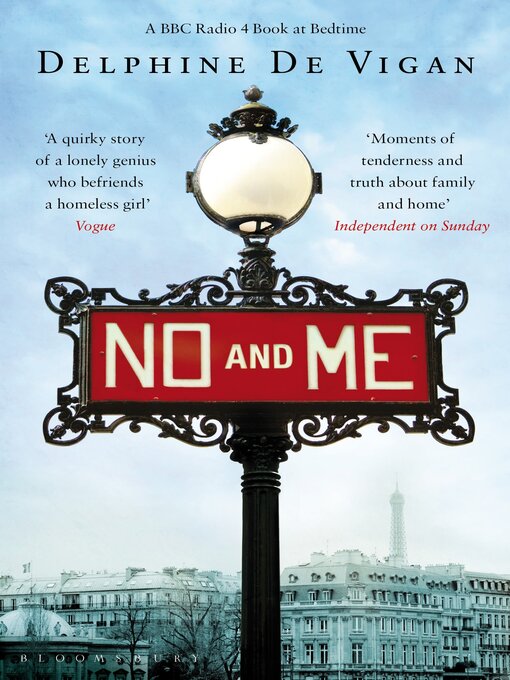
Title: No and Me
Author: Delphine de Vigan
Published: Bloomsbury, 2010

Synopsis:  Lou Bertignac is a thirteen year old, gifted child with an IQ of 160. She wonders about many things such as the base ingredients of frozen food and which way your tongue goes when you kiss. She wonders about all the people who are getting on trains and off trains at the Gare d'Austerlitz, until one day she meets No, a young homeless girl.
 

Star parts: Now as embarrassing as this is after ten years, I was reading this in translation. A good translator can make or break a book. So, first gold star goes to George Miller who did a stellar job. In English there is no formal and informal address, yet Miller managed to get formality across in the translation and where things just wouldn't work, he used English references. Great job.

Now onto the book, I loved Lou. There we go, I'll just get it out there. I loved that she asked all those questions; that she explained how her ideas whizzed around so fast that she couldn't express herself properly; that she couldn't get her shoelaces done. I loved her because her little voice was just so strong and clear. And she made my heart bleed when she reflected on the relationship between her mother and her.

The next good point was that homelessness is a tough subject and yet de Vigan didn't pretty it up. I don't want to give too much away about the ending, but it could have been all a fairytale, but it wasn't and that was part of what made the characters of No, Lou and Lucas so real. The family relationship is also painful, particularly that of Lou and her mother and again it was dealt with realistically.

OK, the ending wasn't all down and miserable, and do you know what? I liked that too, because I wasn't expecting it.

Black clouds: I finished reading this a couple of days ago and I've been thinking and thinking, but I can't think of a single thing I didn't like about it. I found the Paris I know and love in this book, with the villages of 'Quecha' tents that were handed out to the homeless a couple of years ago. I wonder if this book transfers as well because it is so steeped in Paris. I know about everything Lou mentions. Sometimes she mentioned a place name and I could see myself there. So, I do wonder if it works for those who don't live in Paris, or have no knowledge of Paris. It would be interesting to know.


Do I recommend it:Totally and whole heartedly. In my bid to read more French literature, I read everything that I see in translation (I'm lazy!) and this and The Elegance of the Hedgehog are top reads. They are classed as adult reads over here, but having read both, and as both have a teenage main character in it, I think they could both easily be YA/adult crossover. (I know this is a review for No and Me, but I just LOVED The Elegance of the Hedgehog!)

Tuesday, December 28, 2010

Itsy bitsy little practice run

The last time we were in the UK I bought Silly Billy by Anthony Browne. In it, the main character Billy worries about all kinds of things:

He worries about hats,
     He worries about shoes,
          He worries about clouds.

Lately, I've been worrying about the British Book Challenge that I've signed up to do.

I worry that my reviews will not be up to the mark,
     I worry that the books I read will be better than anything I can write,
          I worry that I won't like the books I read.

I suppose on the 'let's worry about more important things' front, I should worry about choosing the books. Who would have thought that in the 9-12 year old, fantasy genre there would be so many Australian writers? Or such a large number of books about dragons? Or books only available in hardback at the moment (such as the Ogre of Oglefort!) But after a little bit of research, I think I have chosen three books to get me started. I'm only starting with three because a) I'm not hugely convinced that I am writing for the 9-12 age range yet, but I can't find a 'tween section on Amazon. b) Because I can't commit myself to twelve straight away, so I'm going to do it in groups of three.

Next there is the how to write the review. In my blog travels I have seen that there there seems to be a certain format for reviewing books, whereas I tend to wibble on endlessly and kind of decide on the spot whether I like it or not. But in the spirit of trying to improve my reviews, and as the title of this post suggests, here is a wee practise run about a book I've just finished.

Title: The Other Hand
Author: Chris Cleave
Published: Sceptre, 2009

Synopsis:   On a sunny Nigerian beach two years ago, successful Sarah Summers and Little Bee fleeing from the men who have attacked her village meet. What happens on that beach profoundly changes both their lives. Two years later; the two meet again in England, Little Bee is now an illegal immigrant and Sarah has just lost her husband and is coming to terms with being a single parent. As their story unfolds we learn where the women have come from and how their lives became entwined. The story goes back and forth from Little Bee's and Sarah's point of view.
 

Star parts: The story starts from the moment where Little Bee is in the queue to leave the Immigration detention centre. Cleave does a fantastic job of weaving the story backwards and forwards in such a seamless fashion, that we never get lost in the story.

Little Bee's life and her reflections are eye opening. In fact the way he builds characters are amazing. Each of the women in the queue come to life before our eyes as we read the pages. The way he gets us to know each character through the see through plastic bags they carry is impressive.

Cleave has an ability to build the tension to such a point that he gets the reader to feel the exact emotions the characters are feeling. When Little Bee describes what ultimately happens to her sister as she is under the upturned boat, it is almost as if you can feel the heat and smell the sand and salt in the sea. There are parts of this story that will stay with the reader for a long time.

Black clouds: But - and I think in retrospect that this may be intentional - Sarah was awful. I found that with every page I turned I grew to dislike her more and more. I had no sympathy for her character and for someone who was meant to be intelligent, she was incredibly stupid, selfish and just downright odious. Towards the end of the book when she turns up on the plane you just know that the simple fact of her being there is an omen of catastrophes to come. That's Sarah's role in the book, to monumentally screw things up.

Another  black cloud was that although on the whole I liked the Little Bee character , I thought she was  older. I was never very clear about her age and it was only halfway through the book when Sarah's character clears up this issue that I realised how very young she was. It then made me think about whether Little Bee would act the way she did. 

Do I recommend it: Personally, I think  hearing an immigrant's story is important, and I think Chris Cleave does too, that's why he wrote the book, but unfortunately, as I close the book this is the overwhelming feeling that I am left with: Cleave wanted to write a book about immigration. Maybe it was the hokey : 'We don't want to tell you about what happens in this book.' blurb on the back or the 'notes' the author felt compelled to include, or the senior editors effusive: 'I hope you love this book as much as I do', but the alarm bells began ringing . If the book is so great why does Cleave feel the need to apologise for not being a Nigerian woman? Why won't he tell us about the book? And of course the senior editor loves the book. So my recommendation is that I half recommend it. If you do choose to read the book, skip those bits and read the book on the basis that it is a story and that Cleave is a halfway decent storyteller. Then tell me what you think.

Sunday, December 05, 2010

Where I grew up

This is where I grew up. It didn't look like this when I was little; then it was a rectangular red brick building with not as many windows and NO toilets. The children's section was separated from the adults section and I remember spending hours flicking through all the children's book, while my Mum was on the other side choosing her reading material for the week.

During the summer holidays, the library would dutifully show Bedknobs and Broomsticks, and my brother and I would dutifully troop off to see it... again. Another thing they would do during the holidays was have themed reads. I got well into The Worst Witch series one half term, because she had a lovely little cat and she just messed things up, a bit like me.

You could say I became a writer at the library, as I would come home and tell my brother and parents stories about all the imaginary friends I played with at the library. Those characters were probably some of the realest, roundest, well developed characters I ever made up.

When I came back from university a bit disillusioned with the way the British education was going and unemployed I lived in that library. I went through the directories there and found voluntary work. I went through the Times Ed every week until I found a job. And more importantly I read loads of trade paperbacks of all my favourite comics, and some that I just thought I would try. I also learnt to cook more than chilli, curry and lasagne. Once a week or maybe more, I would cook my parents dinner. My Mum was generally quite grateful as it meant she didn't have to cook and my Dad just hoped it was a week where I only cooked once and meat would be back, but all those recipes came from books from the library.

These are just some of the memories I have of my library. I no longer live in the UK, but some of the things I miss are a writing community, which is why I blog. I miss certain foods, which is why there is a Holland and Barrat's bag full of meat free sausage mix in my larder. And I miss the library, because I love books and I love the memories that go with my library.

I cannot imagine my childhood without Southfields library and I cannot imagine why the UK Government is planning on closing 250 libraries. Neither can all these people around the blogosphere :
Nicky Schmidt
Jon Mayhew
Lucy Coats
Jude Ensaff
Gillian Philip
Dave Cousins
If you cannot and would like to take action join this page on Facebook: Campaign for the Book official facebook site

Friday, October 08, 2010

Some books I've been reading


At the beginning of this academic year, my boss started a meeting by laying books out all over the room. I was intrigued straight away and offered my opinion on this and that book to my colleagues. I spied a great big thick one and scuttled over to a friend asking her if that was? It was wasn't it.

The next surprise came when the boss said that each one of us was being given a book. She had chosen them carefully and she hoped we would like our gifts. And boy was I pleased when I realised that The Invention of Hugo Cabret was for me. I clutched it to my chest, stroked its cover. I flicked through it on the way home. I wondered when I would finish The Children's Book by A.S. Byatt. For weeks Hugo sat staring at me from his spot on the bookshelf, while I ate lunch or sat at the table.

And finally a few weeks ago, I started reading. Brian Selznick has created something a little different in The Invention of Hugo Cabret. The book starts with a close up of the moon, and then pans away to reveal Paris, a station and eventually our central character Hugo. Through carefully drawn illustrations we are taken on a journey through Hugo's world and introduced to some characters, then the story begins. There is plenty of intrigue, chases, secrets and suspense, but I kept waiting for Hugo to appear on the page.

He is there, the book is all about him, but something kept nagging at me as I ploughed on through the book. Something was missing. First of all I thought that perhaps the pictures interrupted the flow of the narrative, but I knew that couldn't quite be it. I've been a fan of graphic novels for many years and having pictures instead of words never bothered me, sometimes the artists did, but Selznick's artwork cannot be faulted.

As Part I finished it began to get a bit clearer and by the almost final scenes I knew what it was. Hugo was never really invented. He never came alive for me on the page. The book contained all the ingredients that I love in books, except one; a character who I cared about.

The Children's Book, which incidentally is not really a children's book, is full of characters you care about. There is a line near the beginning where Tom ponders on whether he will like another character Julian, and you the reader end up feeling the same way. Byatt draws us into the lives of all these characters, so that by the end I was almost angry with her for finishing her book the way she did. I wandered around a bit shell-shocked and then just shocked at what she had achieved.

Both books were written by people who had become passionate about their subejct. Selznick's love of cinema is echoed in the way he has framed the text and his use of illustration, but by the end of the book, it's more about the subject he loves than the characters. Byatt has pages of coldly written matter of fact passages that place the reader in history, but when she writes about pottery and the making of pots it is through her characters eyes, their senses, their longing, so that you the reader can almost feel the pot being shaped beneath your fingers that hold the book. 

I'm now reading Her Fearful Symmetry and one line made me laugh out loud last night. Before I closed the book I thought about writing a line like that and I realised I had. I'd written a story full of one liners with no story, but I'll get back to it one day because it keeps coming back. Then I thought of crafting a book the way Byatt had and decided that perhaps I should concentrate on draft two of  a book first. Then I thought about characters, and now I know I really should be getting on with today's homework from writing.com in preparation for NaNoWriMo!

Images from the internet

Thursday, October 11, 2007

Catching up - Part III: A wordy kind of post

So while I’m catching up I go and find myself something else to do. Next Monday is Blog Action Day (see above) and the focus this year is The Environment. I found this while I was searching for some stuff for the Eco-Ecole Club (try saying that very fast, over and over). I figured the little darlings have got enough to be getting on with for the moment, so I’ll do this one. Don’t know what I’m going to post yet. The other options were to donate your blogs’ proceeds of the day to a charity. Hang on! Are you lot making money out of this?

Anyway, I’m now going to tackle the book meme that Vanilla tagged me for ...ooh eons ago. Mmm... when you take out Vanilla’s answers this seems like a manageable book meme.

Total number of books owned
Well there’s a little pile there by the fireplace, that bookcase there, there’s some more on the phone table, that other bookcase...Look everywhere I am there are books: at home, at work, in my bag, there’s even a book under my pillow. I have more than enough for one person really, but then again you can never have enough. Does that answer your question?

Last book bought
I don’t live in the land of readily available English language books, then again I’m not deprived of books, but I do like to make part of my trips back to Blighty involve book shopping. So I bought:

The Weather Makers by Tim Flannery

Twenty love poems and a song of Despair by Pablo Neruda

Lady Friday by Garth Nix, the 5th in the Keys to the Kingdom series. I’m not entirely sure about this series of books, but the first book, Mister Monday has got probably the best prologue I’ve ever read.

The Art of Travel by Alain de Botton.


Last book read

The Weather Makers by Tim Flannery and Coven of One by ole Minx.


Five books which mean a lot to you

Only 5...

The House at Pooh Corner by A.A. Milne. If I can’t cross a bridge without playing Pooh Sticks, it’s because of A.A. Milne, and E. H. Shephard’s drawings. I really dig Pooh bear because there are days when I feel of very little brain. You know if we all lived our life like Pooh we probably wouldn’t get an awful lot done, but we’d eat a lot of honey!

Setting Free the Bears by John Irving. It was probably the first book that made me cry. It was hysterically funny, so full of historical resonance (the first time I read it was as the then Yugoslavian state began to fall apart) and dreadfully sad too. And yeah I’ve read it a few times along with quite a lot of other Irving books.

Love in the Time of Cholera by Gabriel Garcia Marquez. I read this shortly after moving to Mexico. Living in Latin America so fully explained why Magic Realism emerged there and vile pretenders like Louis de Berniers will never do anything more than write poor parodies. Anyway back to Love in the Time of Cholera; Marquez draws you in and makes you believe absolutely every word. Your heart beat quickens, you sigh and gasp, its beauty on a page.

Heaven Eyes by David Almond. I remember putting the book down in complete awe and realising I had just read the best Magic Realist since Marquez. Who is Heaven Eyes? We never know, but this is a story that will stay close to your heart for years to come and fill you with hope.

Oh no... I’m at five and there are so many more... Ok. Last year I read History of the World in 10½ chapters. You couldn’t put a more disparate bunch of themes together and tie them together with a woodworm if you tried, or unless you were Julian Barnes. I have an absolutely terrible memory and yet I think I can just about remember everything he writes about love in the chapter entitled parenthesis. This is the sort of love I want to believe exists.

I’m not going to tag anyone for this meme as it’s been going around for a while and if you haven’t done it already then you SHOULD. Let me know if you do have a go. Also as this is quite long I won’t add a Phoktober bit, but do check it out here. I’ll catch up on that tomorrow!

Saturday, September 01, 2007

Purple Mail

So there I was yesterday feeling at a bit of a loose end when I went downstairs and opened my mailbox. I was expecting some sort of courrier informing me that my ten month work sentence starts on Monday, but instead it was rather book shaped squishy little thing. “No,” I feverishly began to tear open the package. “It can’t be,” I scrabbled at the ripped open edge to pull out the contents. “It can be!” I stared at its glossy purple cover. “It is be!” I exclaimed as I opened the cover and saw my name there.

I took it with me on my little shopping excursion with Claire. “Look!” I waved it at her. “The first book where the author has written a little message to ME.” Then I frowned. “Actually that’s not true Jack Gantos signed my copy of Joey Pigza swallowed the key.” But then I smiled. “No, the first author I nearly really know who has written a little message to me.” Then I frowned again. “Shame I can’t keep it.”

But you see keeping it is not the deal. This is the deal: a couple of months ago Kate Bousfield otherwise known as Minx ran a Small but Perfectly Formed Competition. Unfortunately what with it being during crazy silly season, I could only watch as the entries came in and I knew that I would not be one of the winners (well it stands to reason doesn’t it, if you don’t enter you can’t win). But ever generous Minx didn’t leave it at that, she then decided to run another little thing. For a kindly PLEASE, Minx would send the book to you and it would go on a kind of book tour without the author. It’s a simple deal really: you read the book, you review the book (on your blog and Amazon) and you pass it on. So who wants to read a Coven of One next? I only got it yesterday and I’m already on page 148.

If you would like to be part of this book tour then drop me a please in the comments box with your e mail address.

More information about a Coven of One can be found here.

Friday, August 31, 2007

The End

So everything seems to coincide, I finished Tim Flannery’s The Weather Makers. The solutions to Climate Change were a bit thin on the ground; well really it boiled down to stop using coal now and this relies heavily on Government intervention, big business taking action and responsible conduct on our part. Well as we know, not all Governments have ratified the Kyoto agreement. Big business? Well if BAA’s recent behaviour over Camp for Climate Change is anything to go by I guess that BP must be the lone crusaders on that front. And responsible conduct on our part? Well I try, I buy green products, recycle, reduce my energy as much as possible and swapped to energy efficient bulbs, I don’t drive and I download music. On the minus point I then burn the CD’s for my friend’s birthday, combining the cover and the card together which I then slip into a lovely jewel case. I go to Music Festivals, now according to William Shaw at Word magazine, it’s alright that I travelled by metro to get there, but I checked the line up of Rock en Seine and Reading and Leeds Festival which was on the same weekend: Arcade Fire played Paris on Friday, Reading on Saturday and I think you can guess where they were on Sunday. So, the upshot of reading the book is that I am left feeling a little pessimistic about the future of the planet; however, I did gain a better understanding of the difference between weather and climate, why Climate Change was happening and how it will affect us. Remember the Inuit? Well, if we don’t change things they are likely to become the first people to lose their land through Climate Change.

I also finished writing my book. It closed at just over 80,000 words, which is a little bit more than I thought it would be at the beginning of the summer. Vanilla has advised me to leave it alone for a little while now. Now it’s not that I don’t take fellow writers advice, but I did then rush off and go and pick up Masello’s book, which now has a wee little layer of dust after over three weeks on the top of my pile of books to read. Rule no. 27 is Let it marinate. So I spent yesterday drawing a picture. I know that my description is a bit thin on the ground so I figured if I drew it then it would be easier to describe it when I go back to it. I also spent hours looking up Cornish, Breton, Icelandic, Faroese, Swedish, Danish, Norwegian and Finnish words. I changed all the place names. OK that’s not leaving it alone, but I didn’t read it, hitting the ‘replace all’ key on Word does not constitute reading.

And today is the last official day of the holiday, tomorrow is really weekend. My big wish for this weekend is that there is a freak meteor shower and a big lump of molten rock comes whooshing through the skies and splits up and coincidentally crashes into and burns to a crisp all the buildings that make up my place of work. Failing that one of my colleagues returning from their exotic holiday will display signs of an extremely rare and contagious (but not fatal) disease and when I arrive late (as I always do) the building will be cordoned off and the men in white bio suits will be milling about in a most sci-fi manner and I will be sent home. It’s not that I don’t like my job, I do, but I have spent the summer as someone else and it will be a shock to my system to put on those other cloaks. There are two; there’s the multicoloured striped one, which is rather like a Magician’s cloak turning you from scientist, to writer, to mathematician seamlessly, the other is darker cloak full of shadows and Machiavellian plotting and I hope I can get through the year without having to put it on.

Right I’m off to go a lunching and a shopping and maybe have a nice glass of Sangria!

Sunday, July 22, 2007

Dead good innit?

I managed to put my copy of the Deathly Hallows down for a few hours to pop along to the Other Writers' Group yesterday afternoon. During the worst moments of last term, this was one of the things that I was looking forward to doing on a Saturday afternoon.

At the beginning of the session we were asked to introduce ourselves (sigh) and say what books we like reading (sigh). I hate the fact that when you get groups of people together you have to do these faux getting to know you bits. After all, you are about to read out a piece of your own writing which can reveal far more about yourself then any glib comment you make about what you're reading. Still, that's not the point, I'm getting there. Later in the bar one of the members asked me if I had read Rimbaud, to which I replied: No. In retrospect I now realise that I what I should have answered is: Of course not, he's dead. I'm looking at my bookshelves and what I read and it seems that I don't read very many dead writers. In fact the last dead writer I read was Kurt Vonnegut and only because he shuffled off this mortal coil before I had finished reading his book.

I suppose that the logical beginning of this train of thought began when I read about David Lassman who rewrote the works of Jane Austen, changing a few names here and there and then sent them to various publishing houses to see if she would get published nowadays. Unfortunately for Jane, she was universally rejected, but only one publishing house recognised the work as Austen's in the first place. So how well would you do? Try this wee little quiz here. I got a pathetic 4 which is not bad considering I've never read Jane Austen (cos she's dead ain't she?), but I feel a hefty pile coming my way; I mentioned this gap in my literary canon to Claire.

Sunday, June 17, 2007

Books wot I read

Claire often pushes books my way and on the whole I tend to trust her judgement, apart from when she tries to push huge Robert Fisk tomes my way. Sometimes she pushes so many my way I have to tell her to “STOP!” But these are the trials of having a librarian as a friend.

A few weeks ago I wandered into Breakfast Club and lurched about looking for a spoon (you’d be surprised how difficult that can be) and tried to make a cup of tea and found Flowers for Algernon by Daniel Keyes pushed my way. I’m not my best in the morning so I was a bit grumpy about having a book with a white mouse on the cover next to my breakfast, but the general opinion of the Breakfast Club was that it was very good, so I shoved it into my bag with the rest of my breakfast, grabbed my tea and staggered up the stairs and deposited it on my desk before going to get on with my job. Later that same day I collapsed onto my sofa and pulled out the book. When I heard my electricity metre click onto heures creuse I knew it was time to go to bed but I couldn’t put the book down. Just one more journal entry, I thought.

You see the book is about Charlie Gordon. He is a thirty something retardate (as the book calls him) who has been selected to take part in a new experiment. So far the experiment has only been tried on animals and Algernon is their star patient. By the time I went to bed Charlie had already been operated on, could finally beat Algernon at the ‘amazed’ test and was achieving levels of intelligence that you and I can only dream of.

I was two thirds of the way through the book when I read the journal entries that made me gasp and swallow back tears. I was on the metro at the time.

Claire later told me that the book was recommended to her by someone who said it changed them; I can see why. At first you read the book and like the other characters you laugh at Charlie’s misspellings and his way of viewing the world. As he changes you begin to question your view of the world just as Charlie does.

I won’t tell you more, just read it, if you haven’t already. The book has been kicking around since 1966 and even today it has resonance.

The next book I’ve read recently is ‘How to be Good’ by Nick Hornby. I wasn’t expecting to get through much of it, but I had forgotten that my fellow colleagues were all pukers so they needed to sit at the front of the bus and the law says that responsible adults have to sit by the emergency exits, so there I sat. I looked across and told my fellow travellers that I was going to read. They pointed out to me that we were stopping for lunch soon, so I flicked through my Private Eye first and after lunch got started on the book and was only distracted by their gasps of how gorgeous the scenery outside the window was.

How to be Good starts off as a laugh a minute ride, seriously I was laughing out loud, even though it starts off with Katie (the narrator) telling her husband that she wants out of their marriage. About halfway through it stopped being funny. Hornby’s books are anything but easy really, when I think back to the other ones I’ve read: attempted suicide, bullying, relationship breakdowns, being a sad bastard, it’s just this one seemed harder and bleaker. And then again maybe it was the subject matter, the utter breakdown of a marriage, being together but hating each other. Being so miserable, but not knowing what else to do. If anything this book is so excruciatingly accurate that it ends up being painful to read. I’d recommend it, but only if you are in a stable, happy relationship!

This post was inspired by this. He he.

Monday, April 09, 2007

Tout Noté

On Saturday after an exceptionally long gym class I got the metro up to Blanche so that I could buy a new notebook from my favourite stationery shop. In the past I would go out of my way to go there to buy cards; it was the only place in the north of Paris (in my opinion) that sold decent cards. They also sell photo albums, things, handbags I’ve noticed, wallets, pens and notebooks.

I bought my first notebook up there in August 2005. It was a conscious decision, the one and only thing I had to do that day was buy a notebook. I remember that what I liked about it was the feel of the cover; it felt soft and sexy under my fingers. Inside the pages were cream coloured and stiff, you can flick them and they don’t bend. It was spiral bound so you can turn the pages a full 360°; two little silver rings hold it together at each end. It was burgundy, the colour of wine. It was A6 size, compact enough to fit into a bag or pocket, but large enough for my thoughts. The first line in it is: This is today’s method of saying yet again: ‘Today is the start of the rest of my life.’

I started the second one on the 1st April 2006: So it’s the first of April ha ha! And here’s what I have discovered: I am seriously allergic to something. Yeah, it turns out it was strawberries; hysterical huh? Anyway this notebook is olive green and by then I seemed to have developed the habit of using only my parker fountain pen to write in it. In fact I distinctly remember making a note about it one day when I was without it. Ah yes there it is: Left my pen in Gluepot’s office yesterday, will that make my thoughts different? Apparently the answer is yes; because that was the day I experimented with trying to deal with everything as a man! Four months later I had completed this notebook and this one ends on a beach in Bali. It was my last day in Bali and I think I was feeling a little melodramatic. I think I should add beneath this entry (there’s a little bit of space): please shoot me if I ever write a line as bad as this again.

There was a bit of a break between ending the 2nd one and starting the 3rd one; moving got in the way I think. Anyway eventually I bought it and I started it with the line: I knew this one had to be blue, which of course it is, and it’s not finished. In it are scribbled lines of poetry, beginnings of stories, ponderings about my life, thoughts about books I’ve read, ideas for posts, lists of things to do while on holiday, analysis of my dreams, how I will stage the Crane Wife (well a millisecond of it and it’s the costumes that are clear in my head more than anything) and then this poemy thing:

I watched him play with time
between his fingers:
stretching it,
snapping it,
stopping it
as if it was a pliable material,
like plasticine,
instead of the steady march of
seconds,
minutes,
days and
years
that I knew it to be.

Copyright, 2007. Verilion

Since then about 18,000 more words have poured out. In 2004 I wrote 36 chapters, the furthest I ever got. There are nine different versions, each one ranging between 6,000 and 30,000 words. Out of all those words, one idea and the name of one character have stayed the same and I think I know where I went wrong before. So I bought a new notebook. It’s red, it’s just a bit smaller than A4, the paper is still blank but thinner because I may rip pages out. I’ve divided it into sections: possible titles, characters, drawings, time line of events, glossary of terms and the rest for actually writing the damn thing. I think I’ve got it all. I’ve planned out all the events; in more detail for the bits I’ve actually written and very sketchy for the middle and end, but I know where I’m going, it just seems right. In the past chapters 12 – 14 have been where I’ve got super stuck, so I’m avoiding chapters for the moment, it’s just one long stream titled things like: the bit after the beginning, the next bit after the beginning. I don’t feel like I’ve got to sit down at my computer and spew for hours on end in case I forget it. It’s growing, it’s taking on a form of its own and eh... well that’s it really. Suppose I better go and write some of it now.

Sunday, March 18, 2007

Reading Week

On Thursday I came home knackered. Within minutes the sleeping bag was dutifully bundled on to the sofa, the ashtray was at arm’s reach, as were fags, lighter and bottle of water. A snack of veggie pate and marmite on toast lay on my belly. The socks disappeared down the end of the sleeping bag to migrate to that place where right socks live and I was settled. I was not going to move until I’d finished the book...

And it would have been nice if the story had ended like that but unfortunately life has a way of intervening and instead I found myself dismantling an IKEA desk at record speed while swearing profusely (it speeds up the process) and loitering around in the street waiting for a delivery man to arrive...

And then I got back to my sofa... and finished the book.

So the first book I finished this week was The Child in Time by Ian McEwan. As you read it’s as if he is pulling a noose of words around you tighter and tighter until all your senses are stretched to snapping point, hyper aware of everything the characters are going through. McEwan drops hints of reprieve, then pulls out the ground from beneath you, leaving you falling and gasping.

On returning to awareness all is calm again although there is a sense of pent up frenzy building up, of mistrust. Can McEwan possibly lead you to a satisfying joyful conclusion?

The last pages of description are so lyrically graphic that you can almost feel, hear and smell the scene beneath your fingers and then it is followed by the final full stop.

It’s over; you have experienced the protagonist’s breakdown and slow renewal.

As I was surfing blogs recently I remember catching sight of Mortal Engines by Philip Reeve. The blogger had described it as the best YA fiction they had read recently and I remembered that when I went to get some books from the library recently that Claire had pressed this book into my hands. After half tidying my desk I found it below Fear and Trembling by Amelie Nothomb (I’m half wondering whether to read it in French so haven’t started it yet). Anyway, the metro journey wasn’t long enough for Mortal Engines; I was still reading it as I trundled up the stairs at my stop. It’s a thrilling story set on the future Earth warning us of our self-destructive tendencies. There’s adventure, some cool characters and a nice look at developing young lurve. While I loved the story line, I wasn’t too sure about the device of using present tense for certain characters. And also in the thrill of the story’s breakneck forward thrust, I kind of got the impression that some of the characters were inconsistent or that parts of the plot hadn’t been followed through sufficiently. Still it was a ‘thinking’ book, which gives it a thumbs up in my book. Mmm... I see there are a whole series of books. Oh I’ll have to check those out.

Saturday, February 03, 2007

CED – complete and unabridged*

On Monday I spent something like ten minutes googling the word ‘communion’. In my head I had this idea that there were various other meanings that did not involve a wafer thin host. Despite this certainty Google was not initially forthcoming. And then it slapped me in the face: I don’t have a dictionary. What sort of writer doesn’t have a dictionary? I used to have a dictionary, or rather I lived in a house where there was a dictionary and when I left that house the dictionary sort of accidentally on purpose ended up in my boxes. The only problem with that little ploy was that when I needed somewhere to store my stuff when I moved to Mexico, I used the same house that I had pilfered the dictionary from in the first place. I was left with no choice but to return it to its rightful owner. Then as I may have mentioned before I moved eight times and on seven of those occasions there was always a dictionary in the house, as well as a BIG Spanish-English dictionary and a BIG French-English dictionary, but no BIG English dictionary and recently before my eighth move no dictionary at all and it didn’t seem a problem until Monday night.

So how do you choose a dictionary? The first decision involves deciding where to buy it. I didn’t want to turn up at home with a huge tome and discover I had accidentally bought a US English Dictionary. To limit the probability of that event I decided to go to the hugely over-priced WHSmiths on rue de Rivoli. I thought it would be hard to focus on buying the dictionary and I would get distracted by all the millions of fictional words around me. I was distracted until I turned them over and the 19€ price tag brought me crashing back to reality. So having wended my way to the little room where all things Englishy may be found I discovered that I didn’t really have that big a decision to make: Collins or Oxford English Dictionary. Oh, I had kind of hoped I would have a little more choice to make.

So I pulled the display copies off the shelf and read the definition of communion in both: communion 1 an exhange of thoughts, emotions, etc. 2 possessing or sharing in common; participation 3 (foll by with) emotional or spiritual feelings (for):communion with nature. And then we get onto the religious definitions... Yep, I was definitely communing with this dictionary. The Oxford definition left me cold. But was one word enough to clinch it? So, I turned to the word I once thought I had invented: tootles. Tootle 1 to go, esp by car. Mmm, Oxford mentioned in a lesiurely manner which fit in more with my definition that to tootle was to do so in a Pooh bear state of wandering. But then I found toodle-pip in the Collins and I decided that actually the definition of communion was more important than a word I had defined years ago.

And now that I have the nearly 2000 page tome propped open beside me I’m finding out all sort of stuff, like did you know that ‘butters’ is British slang for very ugly? Or that drink-dialling is the inadvisable practice of making a phone-call while drunk?

* although I was tempted to call this post milf!

LinkWithin

Related Posts Plugin for WordPress, Blogger...